In my youth, itching to leave my hometown and experience the big wide world, I did what so many others on the peripheries of empire have done, and headed straight for the metropole, for the heart of it all.
A little under eleven years and countless visa fees later, I became a British citizen on 5 August 2026 at Hackney Town Hall. I wore my pounamu, the one given to me by my favourite aunt, my namesake. As I sat in the art deco waiting room, sweat trickled down my back. Outside, crunchy leaves flooded the park. We new citizens, people from a couple dozen countries — Brazil, Nigeria, Portugal, Ghana, Venezuela, Moldova, France, Canada, Romania, Vietnam — made small talk: where are you from? how long have you been here?
Later, in the council chamber, after the oath, we took our turns getting a photo (£10) with the Council Speaker and our fresh certificates of naturalisation. A photograph of the King stood in the background, while a playlist of UK music rang out from the speaker in the corner. The Beatles, Oasis, Rita Ora. Dua Lipa played while I took my turn.
This has all got me thinking about what it means to be British. For a long time, even throughout the naturalisation application process, I thought of becoming British simply as a matter of expediency: something that would make it easier to live the life that I want to live.
Then I got the email that told me my application had been successful and invited me to apply for a citizenship ceremony. Then my brain kicked in: What have I done? This wasn’t helped by a New Zealand friend texting me, “That country, really?”
That country. A country that owes more carbon debt than almost any other, and that may, in the midst of a summer marked by devastating fires and droughts, still bow to industry pressure by opening new oil and gas fields in the North Sea. A country where trans rights and lives are under attack every single day. The country that is imprisoning peaceful climate activists and Palestine Action supporters, sometimes under terrorism legislation, and is prosecuting a barrister who dared remind a jury of their right to acquit according to their conscience. The country of Nigel Farage, of Tommy Robinson. The only UK writer of this century featured on the Life in the UK Test is J. K. Rowling.
At a dinner party the night before the ceremony, we went around the table and all said the two things we would be respectively least and most proud of if we were to become British (only one person there was already a UK citizen). To the former, my friend Nelson said, simply, “Empire.”
Then we said the good things. And it became clear that there was a lot to potentially be proud of, too. Not in a flag-waving, nationalistic sense, but in a humanistic one.
This Britain, the one I’m proud to now formally be a part of, is the Britain of Ali Smith, of Robert Macfarlane, of Max Porter, of Bernardine Evaristo, of Zadie Smith, of Kazuo Ishiguro, of Kamila Shamsie (none of whom were on the Life in the UK Test). The Britain of Phillip Pullman, Virginia Woolf and J.R.R. Tolkien. Of Amia Srinivasan, George Eliot, Iris Murdoch (not on the test).
My Britain is the Britain of Barbara Hepworth, William Morris, Vanessa Bell, Ben Nicholson, Pauline Boty, Lubaina Himid, David Hockney, Bernard Leach, Derek Jarman, Christopher Wren, Ben Pentreath, and Alfred Wallis (not on the test!).
The Britain of Edward Elgar, of Ralph Vaughan Williams, of Benjamin Britten, of Yehudi Menuhin, of Errollyn Wallen, of Judith Weir, of Kate Whitley, of Joanna Forbes L’Estrange, of the Manchester Collective, of the Aurora Orchestra, of VOCES8, of the Gesualdo Six. The Britain of the Spice Girls, Olivia Dean, Freddie Mercury, Charli XCX, David Bowie, Adele, Kate Bush, Harry Styles, Cat Burns, Blood Orange, and Jacob Collier (definitely not on the test).
Mine is the Britain of a thousand more artists and writers and thinkers and musicians who have expanded mine and others’ views of the world.
Of course, when becoming a citizen you don’t get to pick and choose which bits of the country you sign up to. You have to own them all. You get all the messy, depraved, glorious, disgusting, glittering, just-okay, and so-bad-it-would-be-funny-if-people’s-lives-weren’t-actively-being-harmed parts.
Britain is like a sticky toffee pudding containing just a few dead ants. Except that’s a bad simile, because the damage isn’t merely superficial. A better one is this: Britain is like an shiny, rosy, beautiful apple, that when cut open reveals that it’s actually rotten to the core. Not in the sense of “a rotten apple spoils a barrel,” because this isn’t a case of just a few bad apples. It’s structural. It’s a house of cards built on shaky ground. And I guess I have now chosen to make that shaky ground my second home.
There’s no neat resolution to this. All of these things are true at once: I am living in the skin of the rotten apple|This land has already given me so much|Living here, I feel deeply unsettled|This land is fractured|I feel privileged|I am grateful|I am resentful at the very concept of borders, at the idea of someone or some algorithm getting to decide which bodies are allowed where on this vast beautiful earth|The Speaker of the Hackney Council said to us that although none of us can choose where we are born, everyone has the right to choose where we call home|Do we actually have that right, I wondered, in anything but an aspirational sense?
In conclusion (?), I think I need to add a quintessentially British bird to my roster of alternate bird personalities. Perhaps a goldfinch (distinctive) or a grey heron (statuesque) or a nightingale (good singer) (kidding). Perhaps something migrating — a swallow??
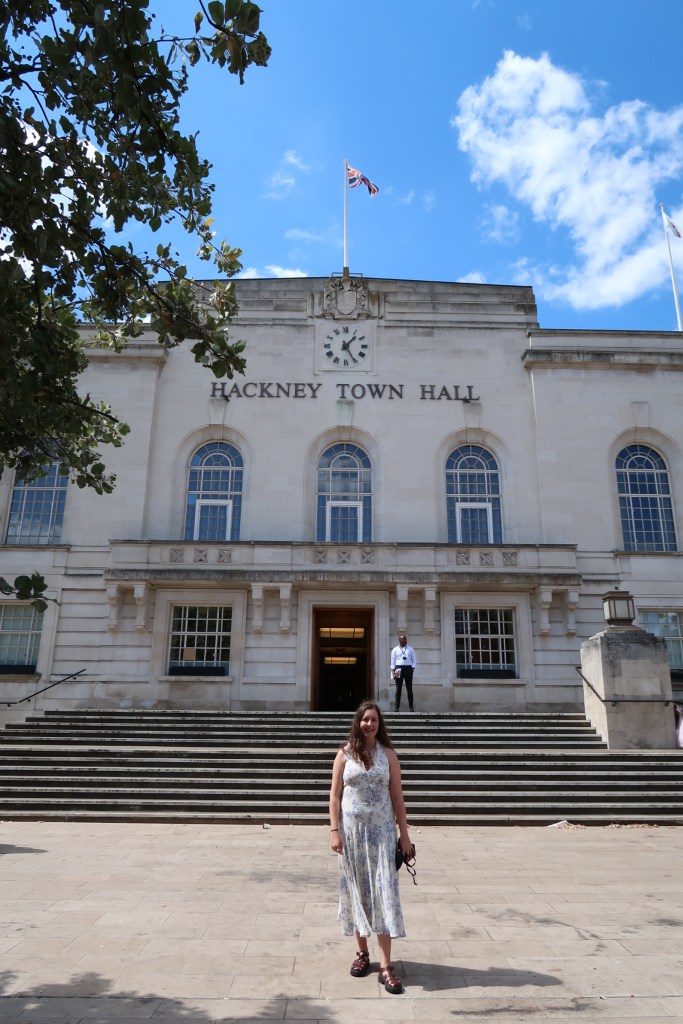
I Wanted A Hackney Town Hall Wedding But All I Got Was This Citizenship Ceremony


