The Legal Risk of Approving Denniston Coal: New coal extraction and the role of combustion emissions in environmental impact assessment

Bathurst Resources recently filed an application under New Zealand’s “fast-track” legislation to open the largest coal mine in the country’s history on the Denniston Plateau in Te Waipounamu / the South Island. In this post I’ll explain why a decision to approve the Denniston mine would carry both domestic and international legal risk. Along the way I’ll touch on why there’s no room for new coal mines in Aotearoa New Zealand (or anywhere in the world) if the world is going to stay within its Paris Agreement temperature guardrails. Grab a cup of tea, this post is 5,000 words long.

Background

Australian-listed mining company Bathurst Resources recently filed an application under New Zealand’s “fast-track” legislation to open the largest coal mine in the country’s history on the Denniston Plateau in Te Waipounamu / the South Island. The mine would cover an area of 3,000 hectares (seven times the size of Auckland’s CBD), including on public conservation land, and in an area with unique and rare ecosystems and species. As part of the project, 20 million tonnes of coking coal would be mined for export over 25 years, resulting in emissions of at least 53 million tonnes (for context, New Zealand’s entire annual net emissions is 59 million tonnes).

One key feature of Bathurst’s application for the Denniston mine is that its climate assessment excludes all emissions from the downstream combustion of the mined coal. This is a key issue that I’ll get on to later.

Due to the timing of the application, it can’t be approved before New Zealand’s general election on 7 November 2026. Depending on the outcome of the election, Bathurst’s application may be declined, or indeed the fast-track legislation may be scrapped altogether. But I write the following analysis under the assumption that after the election the government in power is minded to approve Bathurst’s application.

Scientific context: No room for new coal mines in a 1.5C world

But let’s take a step back. There is an emerging scientific consensus that there is no need, and indeed no room, for new coal mines if the world is to stay within Paris Agreement temperature guardrails. In the International Energy Agency’s (IEA) Net Zero Emissions by 2050 Scenario (NZE), first published in 2021, there is no need for new coal mines (or indeed, new oil and gas fields). This is because committed emissions from existing and under-construction oil and gas fields and coal mines take the world far past the global ‘carbon budget’ that can be emitted if the world is to have a fair chance of stabilising global temperatures. Developed coal mines alone break this budget. In 2023 it was calculated that almost 60% of the fossil fuels within already operating or under-construction extraction sites cannot be burned if the world is to stay within the 1.5C limit (a figure that has no doubt only risen since).

In this context, there is no room for new coal extraction infrastructure. One reason for this is that, from a political economy perspective, it’s generally much easier to stop new coal mines than close existing ones: existing projects have had capital sunk into them, meaning their developers’ interests lie in continuing to operate them for as long as economically feasible. In addition, legal barriers often also exist to governments enacting regulations that decrease the value of existing investments (i.e. international investment law).

Okay, so that’s a global analysis. Does it allow for any regional/national variation? What if mining coal in New Zealand stops coal from being mined elsewhere? The short answer is: not really—there’s no atmospheric exemption for New Zealand coal (h/t Kevin Anderson). To draw on Anderson’s excellent analysis: the atmosphere does not distinguish between a tonne of CO2 and another tonne of CO2, no matter where they are emitted from. If New Zealand develops additional coal production, that does not mean an equivalent quantity of production elsewhere automatically stops. Rather, doing so would add additional coal supply to an international market.

Domestic legal risk: potential unlawfulness of not taking combustion emissions into account in environmental impact assessment

If the Denniston mine is consented, this decision could be challenged on appeal to the High Court. Precedents from the United Kingdom, Norway, the European Court of Human Rights, and the advisory opinion of the International Court of Justice (ICJ) support the position that it is unlawful for a decision-maker to not take combustion emissions into account when making a decision to provide consent for upstream fossil fuel infrastructure. That’s certainly not the only ground on which an appeal application could be made – but it’s the one I know the most about and hence will focus on here. This section addresses the UK, Norway, European, and international law elements in turn, then draws implications for the Denniston mine.

United Kingdom: Finch v Surrey County Council

On 20 June 2024, Lord Leggatt handed down the judgment of the United Kingdom Supreme Court in Finch v Surrey County Council [2024] UKSC 2020. In this case, the Supreme Court found, in a reversal of the decisions of the lower courts, that the Surrey County Council acted unlawfully in its grant of planning permission for an oil extraction development at Horse Hill, because it failed to assess the greenhouse gas (GHG) emissions that will inevitably arise from the combustion of the oil (so-called ‘Scope 3’ emissions).

The case turned on the interpretation of Directive 2011/92/EU as amended by Directive 2014/52/EU (‘the EIA Directive’) and the Town and Country Planning (Environmental Impact Assessment) Regulations 2017 (‘the 2017 Regulations’), which transpose the EIA Directive into UK law.

The basic rule is that planning permission cannot be granted for projects that are likely to have significant effects on the environment unless an EIA has been carried out in respect of that development (article 2(1); Regulation 3). The EIA must ‘identify, describe and assess in an appropriate manner…the direct and indirect significant effects’ of the project on specified environmental factors, one of which is ‘climate’ (article 3(1); Regulation 4(2)). This description should cover ‘the direct effects and any indirect, secondary, cumulative, transboundary, short-term, medium-term and long-term, permanent and temporary, positive and negative effects of the project’ (EIA Directive, Annex IV, para. 5). The Finch case concerned the interpretation of those words.

The Supreme Court reasoned that whether Scope 3 emissions constituted “direct or indirect significant effects” of the project on climate was a question of causation (para. 65). It was agreed among the parties that it was ‘inevitable’ that the extracted oil would be sent to refineries and that the refined oil would eventually undergo combustion, which would produce GHG emissions (para. 7).  

The Supreme Court found that the causal connection between the proposed project and the resulting Scope 3 emissions satisfied not only the “but-for” test, but the ‘strongest possible test of causation’, which ‘requires the occurrence of event X to be both a necessary and sufficient condition for the occurrence of Y’ (paras. 68-69, 79-80). In this case, it was ‘known with certainty’ that the extraction of oil ‘would initiate a causal chain that would lead to the combustion of the oil and release of greenhouse gases into the atmosphere’ (para. 79). Thus, ‘the extraction of the oil is not just a necessary condition of burning it as fuel; it is also sufficient to bring about that result because it is agreed that extracting the oil from the ground guarantees that it will be refined and burnt as fuel’ (para. 79). Indeed, as the court put it early in the judgment (para 2):

The whole purpose of extracting fossil fuels is to make hydrocarbons available for combustion. It can therefore be said with virtual certainty that, once oil has been extracted from the ground, the carbon contained within it will sooner or later be released in the atmosphere as carbon dioxide and so will contribute to global warming.

The Supreme Court rejected the High Court’s argument that because the oil would undergo an intermediate process of being refined in a separate facility, this disrupted the chain of causation between the extraction and the Scope 3 emissions, finding that ‘[t]he process of refining crude oil does not alter the basic nature and intended use of the commodity’ (paras. 118-126).

On the distinction between “direct” and “indirect” effects, the court found that on a natural, social-sciences definition of a direct effect as ‘an event which is not mediated by one or more variables’, combustion emissions are direct effects of the extraction of oil ‘because they are almost entirely independent of any intermediate variables’; that is, ‘there is no need to know anything about where the oil will go after it is extracted or what the oil will be used for or when or where it will be burnt’ (paras. 84-85). An alternative definition of “indirect effects/impacts” is found in the European Commission’s 2013 Guidance on Integrating Climate Change and Biodiversity into Environmental Impact Assessment: ‘Effects/impacts that occur away from the immediate location or timing of the proposed action…or as a consequence of the operation of the project’. On this definition, the court found, combustion emissions are indirect effects of the oil extraction project (paras. 88-90).

Subsequently to the litigation, the United Kingdom released new guidance that requires oil and gas companies to consider end-use emissions associated with oil and gas production in their environmental impact assessments when applying for development consents.

Norway: Greenpeace Nordic & Natur og Ungdom v Norway

The Finch case followed similar litigation in Norway. In January 2024, the Oslo District Court in Greenpeace Nordic and Natur og Ungdom v The State of Norway (represented by the Ministry of Petroleum and Energy) (Case No 23-099330TVI-TOSL-05) decided that in implementing the EIA Directive in relation to development consent for three oil and gas extraction projects (Breidablikk, Tyrving, and Yggdrasil), there was a ‘legal requirement to assess the environmental impact of combustion emissions’, as they were ‘such a significant and particularly characteristic effect of these kind of projects that they must clearly be considered indirect climate effects’ within the meaning of the EIA Directive (pp. 26, 53-56).

The Court held that the wording of the EIA Directive was broad, with no distinction made between direct and indirect greenhouse gas emissions (p. 52). It said, ‘[t]he whole purpose of petroleum extraction is to make geologically stored carbon available in the form of oil or gas’, and that GHG emissions ‘from the carbon are thus both an inevitable and intentional effect from the project’ (p. 53). Indeed, if combustion emissions were not included, the provisions of the EIA Directive on the assessment of indirect climate impacts from petroleum operations would ‘in practice have no real content (p. 54).

Europe: Greenpeace Nordic v Norway and the EFTA advisory opinion

On appeal from the Norwegian district court decision, the Borgarting Court of Appeal requested an advisory opinion from the EFTA Court. In its judgment, the EFTA Court agreed with the Oslo District Court and held that environmental impact assessments of a petroleum project’s probable significant effects on the environment must include ‘a reasoned estimate of the greenhouse gas emissions that are likely to result from the subsequent combustion of petroleum and natural gas extracted in the course of a project’ (paras. 89, 99).

In so holding, the court noted that ‘the release of greenhouse gas emissions is very likely to follow the antecedent action of extracting petroleum and natural gas in a project such as that at issue’; ‘[i]f not for the project, the embedded greenhouse gases would stay below ground’, such that ‘the extraction of the petroleum and natural gas represents a necessary precondition of burning it as fuel, thereby releasing emissions with an impact on the climate’ (para. 69).

In parallel to the domestic case in Norway, the two organisations applied to the European Court of Human Rights (ECtHR) for relief. On 28 October 2025, the ECtHR handed down its decision. It found that Article 8 of the European Convention on Human Rights (right to respect for private and family life) imposes the procedural obligation on States to conduct an adequate, timely and comprehensive environmental impact assessment in good faith and based on the best available science before authorising a potentially dangerous activity that may be harmful to the right for individuals to effective protection from serious adverse effects of climate change (paras. 292, 314-319).

The Court considered that petroleum would not have been extracted but for the opening of an area for extraction and the granting of production licences, and the fact that other events and permits are also necessary before extraction can take place does not break that chain of causation (para. 294).

The Court therefore held that environmental impact assessment must include not only direct GHG emissions from the project itself, but also combustion emissions ‘both within the country and abroad’ (para. 319).

International law: the ICJ Advisory Opinion on Climate Change

On 23 July 2025 the ICJ delivered its landmark Advisory Opinion on the Obligations of States in Respect of Climate Change. The opinion provides authoritative legal guidance on states’ obligations to address climate change and prevent significant harm to vulnerable countries and communities. While the opinion is non-binding, it makes clear that failure to act can trigger legal consequences.  

After reaffirming that due diligence includes the duty to conduct EIAs for activities undertaken within a state’s jurisdiction or control, the ICJ ruled that end-use emissions from burning extracted fossil fuels must be considered in EIAs for fossil fuel projects. It observed that ‘possible specific climate-related effects must be assessed as part of EIAs at the level of proposed individual activities, e.g., for the purpose of assessing their possible downstream effects’ (para. 298). While the court used the word “downstream,” meaning that in the context of a project proposal for fossil fuel extraction, it could refer to a number of different emissions categories under the GHG Protocol, the most significant such category is the so-called Scope 3, Category 11 emissions that come from burning the extracted fuel.

It is, the ICJ said, for each state “to determine in its domestic legislation or in the authorization process for the project, the specific content of the environmental impact assessment required in each case” (para. 298). However, this must be read subject to the court’s above statement that downstream effects must be assessed where relevant.

Corroborating this interpretation is the statement earlier in the court’s opinion on the scope of the relevant conduct for the purposes of the advisory proceedings. Such conduct ‘is not limited to conduct that, itself, directly results in GHG emissions, but rather comprises all actions or omissions of States which result in the climate system and other parts of the environment being adversely affected by anthropogenic GHG emissions,’ including ‘both consumption and production activities’ (para. 94). Fossil fuel production, then, is “relevant conduct” that can be subject to international law. Reading the court’s statements on EIAs in light of this consideration, it is even clearer that EIAs must, in the case of proposed fossil fuel production projects, consider end-use emissions from burning extracted fossil fuels.

In a joint declaration, Judges Bhandari and Cleveland elaborated on this aspect of the Court’s opinion. Stating that fossil fuel emissions ‘contribute overwhelmingly to climate change,’ and that it is ‘unimaginable that States can achieve their obligations … without a rapid and drastic reduction in—and the phasing out of—fossil fuel production and dependency’ (para. 1), the judges highlighted that fossil fuels ‘are produced in order to be burned,’ and that states “must therefore factor these consequences into their assessment of the harms that such production contributes to the climate system” (para. 14). In other words, ‘States are required to account, in their assessments of environmental risk, for the increased concentration of GHGs in the atmosphere that will foreseeably result from, inter alia, production, licensing and subsidy activities’ (para. 15). Judges Bhandari and Cleveland specifically stated that this obligation stems not only from the due diligence obligations, but also their obligations under Article 2 (objectives) and Article 4 (nationally determined contributions) of the Paris Agreement (para. 15).

Implications for Denniston Coal

The application for the Denniston mine was submitted under the Fast-Track Approvals Act 2024 (FTAA). Under Article 43(3)(a) and Schedule 5 (clauses 5 to 9) of the FTAA, the application must include an assessment of the ‘actual and potential effects’ on the environment, including ‘any effect on natural and physical resources that have aesthetic, recreational, scientific, historical, spiritual, or cultural value, or other special value, for present or future generations’. Arguably the atmosphere is a resource with such special value. It also must cover ‘any discharge of contaminants into the environment and options for the treatment and disposal of contaminants’; arguably GHG emissions are such a contaminant.

The same reasoning at play in Finch and Greenpeace Nordic applies to the Denniston case. Combustion emissions are an inherent result of mining coal. The very purpose of mining the coal from Denniston would be to sell that coal so that it could be burned for energy. If whether something is an “actual effect” of the project is a test of causation, the test is clearly passed. Arguably, then, the legal interpretation of “actual effects”, on the face of those words, includes combustion emissions.

Is this a pretty simple approach to statutory interpretation? Yes. Could a more holistic assessment, including the statutory purpose, change this answer? I don’t think so. Experts in New Zealand statutory interpretation/fast track legislation are welcome to chime in.

 I therefore see the following implications/possibilities for the Denniston mine application:

  • 1. The Environmental Protection Authority could return the application at this stage

Notably, the Environmental Protection Authority (EPA) has the opportunity to decide whether the application is ‘complete and within scope,’ within 15 working days after receiving it (article 46 FTAA). If not satisfied, the EPA can return the application to Bathurst. Here the EPA has an opportunity to do the right (and arguably required by law) thing and return the application to Bathurst on the ground that it does not include an assessment of combustion emissions.

  • 2. The panel could decline the application

The panel could decide to decline the approval (under articles 81(1)(b) and 85(3) FTAA) if there exist adverse impacts that are ‘sufficiently significant to be out of proportion to the project’s regional or national benefits’, even after any conditions or modifications that the panel may set to avoid, remedy, mitigate, offset, or compensate for those adverse effects. There is no requirement for the panel to do so, but it may.

The climate impacts of burning the coal mined from Denniston are indeed out of proportion to any domestic benefits that could be gained from the associated revenues. According to a recent Nature paper, one tonne of emissions in 2020 under conservative assumptions results in around USD 1,000 of damages globally through 2100. Through a simple calculation, one sees that if all 53 million tonnes of emissions resulting from the Denniston mine had been emitted in 2020, this would result in USD 53 billion in damages by 2100 (of course, all emissions from the potential mine will be emitted well after 2020, but the figure stands as a rough estimate). Compare that with the possible revenue of around USD 5.4 billion (calculated on the basis of a USD 271 per tonne cost for coking coal on global markets, the cost on the date of writing this post).

Regarding the possible setting of conditions, it is inherent in the nature of coal mining that there is nothing that can be done to avoid or mitigate the effects of burning that coal later. A condition that Bathurst purchase offsets for burning the coal is a possibility, but would be so expensive that it would possibly render the mine uneconomic (to say nothing of the unreliability of offsets).

  • 3. If the application is approved, an appeal may be taken to the High Court

While the right to appeal is limited under the FTAA (article 99) to questions of law, whether it is lawful for an environmental impact assessment to not consider combustion emissions is clearly a question of law. Any person or group who provided comments in the formal process may appeal to the High Court, and then for leave to appeal to the Supreme Court.

The key takeaway here is that there are options. The EPA has options. The decision panel has options. And if the panel approves the mine application, individuals and groups who were involved in the decision process have the option to take a legal case on the grounds outlined above.

International legal risk: opening new coal mines incompatible with international legal obligations

This section draws heavily on a published (paywalled) article I co-authored with Tejas Rao.

The legal risk of approving the Denniston mine is not only domestic, it is international too.

New Zealand has recognised the jurisdiction of the ICJ as compulsory. The International Court of Justice (ICJ) advisory opinion on climate change means that the contentious jurisdiction of the ICJ could be utilized by willing states to challenge new and existing fossil fuel extraction licenses and permits.

This in turn means that if the New Zealand government approves a new coal mine, like the Denniston mine, it could be subject to a legal case from another country at the ICJ.

This claim could be made under the international legal duty to prevent significant harm to the environment. This duty arises when there is a risk of significant harm to the environment: ‘either where no harm has yet been caused but the risk of future significant harm exists, or where some harm has already been caused and there exists a risk of further significant harm’ (ICJAO, para. 274). This potentially includes the situation where a coal mine has been approved but no coal has yet been extracted and burned. In that situation, only a small amount of harm has already been caused, due to the operational emissions of opening the mine; however, there is a risk of future significant harm due to the fact that substantial amounts of coal would be extracted and burned. It also potentially includes the situation where a coal mine is actively producing.

A State, like New Zealand, could argue that issuing a single coal mine consent does not constitute a risk of ‘significant harm’, since any one extraction project contributes a very small amount of emissions in the context of global total emissions. Such “drop in the ocean” arguments will most likely not be accepted by the ICJ, however: the Court makes clear that a risk of significant harm ‘may also be present in situations where significant harm to the environment is caused by the cumulative effect of different acts undertaken by various States and by private actors subject to their respective jurisdiction or control’, such that individual conduct can give rise to the obligation to prevent ‘even if such activity is environmentally insignificant in isolation’ (paras. 276-277). Thus, even if the burning of coal from an individual coal mine would contribute only a small fraction of global emissions, there may well be a risk of significant harm since it would have a cumulative effect together with combustion from all other coal mines.

According to the ICJ in Pulp Mills, the principle of prevention has its ‘origins in the due diligence that is required of a State in its territory’, and requires the state ‘to use all the means at its disposal’ to avoid environmental harm (para 101). This is an obligation of conduct rather than result, which entails (para. 197):

…not only the adoption of appropriate rules and measures, but also a certain level of vigilance in their enforcement and the exercise of administrative control applicable to public and private operators, such as the monitoring of activities undertaken by such operators.

According to the ITLOS Seabed Disputes Chamber, the obligation of due diligence is ‘an obligation to deploy adequate means, to exercise best possible efforts, to do the utmost, to obtain this result’ (para. 110). The ICJ has held that, in addition to the substantive obligation to take, ‘to the best of their ability, appropriate and, if necessary, precautionary measures’ (ICJAO, para. 136), there are two procedural obligations attached to the obligation of due diligence, an obligation to carry out an environmental impact assessment, and an obligation to notify and consult in good faith (Certain Activities, para. 104):

to fulfil its obligation to exercise due diligence in preventing significant transboundary environmental harm, a State must, before embarking on an activity having the potential adversely to affect the environment of another State, ascertain if there is a risk of significant transboundary harm, which would trigger the requirement to carry out an environmental impact assessment …. If the environmental impact assessment confirms that there is a risk of significant transboundary harm, the State planning to undertake the activity is required, in conformity with its due diligence obligation, to notify and consult in good faith with the potentially affected State, where that is necessary to determine the appropriate measures to prevent or mitigate that risk.

The standard of due diligence, according to the ITLOS Seabed Disputes Chamber, ‘varies depending on the particular circumstances to which an obligation of due diligence applies’ (ITLOS AO, para. 239). The determination of what is required by due diligence calls for an assessment in concreto of what is reasonable under the specific circumstances in which a State finds itself (ICJ AO, para. 137). However, in general the Court has found that the standard of due diligence for preventing significant harm to the climate system is ‘stringent’, since climate change poses a risk of ‘a general and urgent character’ (paras. 137-138).

When it comes to fossil fuel expansion, it makes sense that the standard of due diligence is stringent. The gravity of the outcome if states continue to expand fossil fuel production is immense: going beyond 1.5°C of warming is predicted to have devastating outcomes for people and the planet, including potentially triggering “tipping points” that will accelerate warming.

The ITLOS Seabed Disputes Chamber has noted that ‘[t]he content of ‘due diligence’ obligations…may change over time as measures considered sufficiently diligent at a certain moment may become not diligent enough in light, for instance, of new scientific or technological knowledge’ (para. 117). Similarly, the ICJ has said that ‘where there is generally recognized scientific evidence that it is highly probable that significant harm will occur, the standard of due diligence will be more demanding for all States’ (para. 283). The state of scientific knowledge regarding the perils of new fossil fuel production developments is summarised above. In summary, the science is clear that new fossil fuel production infrastructure, and even a significant proportion of existing infrastructure, is incompatible with avoiding dangerous levels of climate change.

The substantive requirement of due diligence, to take appropriate measures to the best of their ability, includes but is not limited to putting in place ‘regulatory mitigation mechanisms that are designed to achieve the deep, rapid, and sustained reductions of GHG emissions that are necessary for the prevention of significant harm to the climate system’ (para. 282). This arguably includes regulatory measures to end licensing of new fossil fuel exploration and consenting of new fossil fuel extraction projects, to phase out fossil fuel subsidies, as well as to phase down fossil fuel production in a just and orderly manner in accordance with their capacities. The ICJ in the Climate Change Advisory Opinion found that (para. 427):

Failure of a State to take appropriate action to protect the climate system from GHG emissions—including through fossil fuel production, fossil fuel consumption, the granting of fossil fuel exploration licences or the provision of fossil fuel subsidies—may constitute an internationally wrongful act which is attributable to that State.

This statement clearly establishes that activities relating to fossil fuel production, as well as consumption, can breach international law. Earlier in its judgment the Court recognised that international obligations of states with respect to climate protection fully encompass ‘activities such as the production, licensing, and subsidizing of fossil fuels’ (para. 94). In addition, the joint declaration of Judges Bhandari and Cleveland noted that the due diligence obligation to prevent transboundary harm requires states to:

adopt and enforce regulations consistent with reducing global dependence on fossil fuels. This includes phasing out the production and use of fossil fuels, transitioning away from fossil fuels and regulating fossil fuels in a manner that does not undermine global co-operation to achieve these goals, including with respect to subsidies.

Given that no new coal mines are compatible with the 1.5C temperature guardrail, it could be that any government decision to open a new coal mine would be considered a failure of a State to take appropriate action to protect the climate system from GHG emissions that would constitute an internationally wrongful act. In addition, given that burning the fossil fuels from already-operating and under construction coal mines would take the world beyond 1.5C of warming, it may be that a government’s failure to close a significant proportion of its fossil fuel extraction facilities early would also constitute an internationally wrongful act.

Notably, states with greater resources and technical capabilities (like New Zealand) face more demanding due diligence obligations. The ICJ AO noted that states with greater capacities and sufficient resources must ‘do more than a State not so well placed,’ and may be required to provide financial and technological assistance to facilitate transitions in less-capable states (paras. 290-292).

In conclusion, then, it is arguable that the substantive due diligence obligation under the duty to prevent significant transboundary harm requires New Zealand to adopt measures to phase out their fossil fuel production, and their fossil fuel subsidies, in a manner aligned with the 1.5°C goal, including not opening any new oil and gas fields or coal mines, and closing existing extraction facilities early. While of course it is a political question as to whether any other State would in fact take a legal case against New Zealand for, or in part for, opening the Denniston mine, it is a risk that should not be understated. Vanuatu has already made veiled threats against Australia for its fossil fuel expansion.

Conclusion

This blog post has outlined some domestic and international legal risks that would arise if the New Zealand government were to approve Bathurst’s application to develop the Denniston mine under the Fast-track Approvals Act. Quite aside from the moral, ethical, environmental, cultural, social, and political questions that Bathurst’s application brings up, the legal questions are significant and deserve full attention from the EPA, the decision panel, the Minister, the funders of the mine (ANZ Bank, looking at you!) and the public.
On becoming British

In my youth, itching to leave my hometown and experience the big wide world, I did what so many others on the peripheries of empire have done, and headed straight for the metropole, for the heart of it all.

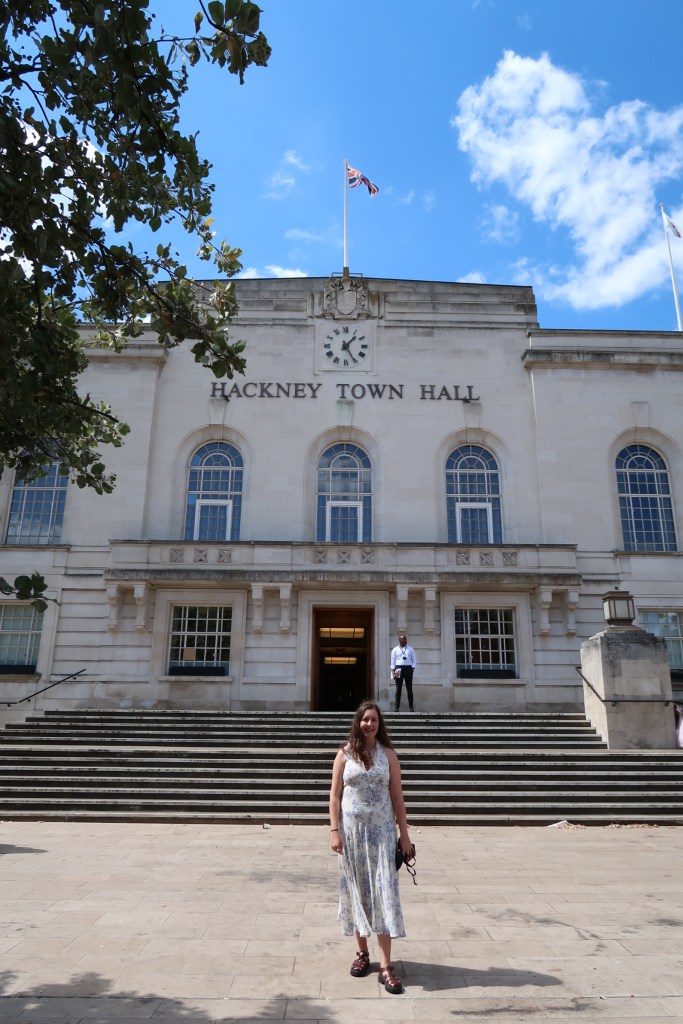
A little under eleven years and countless visa fees later, I became a British citizen on 5 August 2026 at Hackney Town Hall. I wore my pounamu, the one given to me by my favourite aunt, my namesake. As I sat in the art deco waiting room, sweat trickled down my back. Outside, crunchy leaves flooded the park. We new citizens, people from a couple dozen countries — Brazil, Nigeria, Portugal, Ghana, Venezuela, Moldova, France, Canada, Romania, Vietnam — made small talk: where are you from? how long have you been here?

Later, in the council chamber, after the oath, we took our turns getting a photo (£10) with the Council Speaker and our fresh certificates of naturalisation. A photograph of the King stood in the background, while a playlist of UK music rang out from the speaker in the corner. The Beatles, Oasis, Rita Ora. Dua Lipa played while I took my turn.

This has all got me thinking about what it means to be British. For a long time, even throughout the naturalisation application process, I thought of becoming British simply as a matter of expediency: something that would make it easier to live the life that I want to live.

Then I got the email that told me my application had been successful and invited me to apply for a citizenship ceremony. Then my brain kicked in: What have I done? This wasn’t helped by a New Zealand friend texting me, “That country, really?”

That country. A country that owes more carbon debt than almost any other, and that may, in the midst of a summer marked by devastating fires and droughts, still bow to industry pressure by opening new oil and gas fields in the North Sea. A country where trans rights and lives are under attack every single day. The country that is imprisoning peaceful climate activists and Palestine Action supporters, sometimes under terrorism legislation, and is prosecuting a barrister who dared remind a jury of their right to acquit according to their conscience. The country of Nigel Farage, of Tommy Robinson. The only UK writer of this century featured on the Life in the UK Test is J. K. Rowling.

At a dinner party the night before the ceremony, we went around the table and all said the two things we would be respectively least and most proud of if we were to become British (only one person there was already a UK citizen). To the former, my friend Nelson said, simply, “Empire.”

Then we said the good things. And it became clear that there was a lot to potentially be proud of, too. Not in a flag-waving, nationalistic sense, but in a humanistic one.

This Britain, the one I’m proud to now formally be a part of, is the Britain of Ali Smith, of Robert Macfarlane, of Max Porter, of Bernardine Evaristo, of Zadie Smith, of Kazuo Ishiguro, of Kamila Shamsie (none of whom were on the Life in the UK Test). The Britain of Phillip Pullman, Virginia Woolf and J.R.R. Tolkien. Of Amia Srinivasan, George Eliot, Iris Murdoch (not on the test).

My Britain is the Britain of Barbara Hepworth, William Morris, Vanessa Bell, Ben Nicholson, Pauline Boty, Lubaina Himid, David Hockney, Bernard Leach, Derek Jarman, Christopher Wren, Ben Pentreath, and Alfred Wallis (not on the test!).

The Britain of Edward Elgar, of Ralph Vaughan Williams, of Benjamin Britten, of Yehudi Menuhin, of Errollyn Wallen, of Judith Weir, of Kate Whitley, of Joanna Forbes L’Estrange, of the Manchester Collective, of the Aurora Orchestra, of VOCES8, of the Gesualdo Six. The Britain of the Spice Girls, Olivia Dean, Freddie Mercury, Charli XCX, David Bowie, Adele, Kate Bush, Harry Styles, Cat Burns, Blood Orange, and Jacob Collier (definitely not on the test).

Mine is the Britain of a thousand more artists and writers and thinkers and musicians who have expanded mine and others’ views of the world.

Of course, when becoming a citizen you don’t get to pick and choose which bits of the country you sign up to. You have to own them all. You get all the messy, depraved, glorious, disgusting, glittering, just-okay, and so-bad-it-would-be-funny-if-people’s-lives-weren’t-actively-being-harmed parts.

Britain is like a sticky toffee pudding containing just a few dead ants. Except that’s a bad simile, because the damage isn’t merely superficial. A better one is this: Britain is like an shiny, rosy, beautiful apple, that when cut open reveals that it’s actually rotten to the core. Not in the sense of “a rotten apple spoils a barrel,” because this isn’t a case of just a few bad apples. It’s structural. It’s a house of cards built on shaky ground. And I guess I have now chosen to make that shaky ground my second home.

There’s no neat resolution to this. All of these things are true at once: I am living in the skin of the rotten apple|This land has already given me so much|Living here, I feel deeply unsettled|This land is fractured|I feel privileged|I am grateful|I am resentful at the very concept of borders, at the idea of someone or some algorithm getting to decide which bodies are allowed where on this vast beautiful earth|The Speaker of the Hackney Council said to us that although none of us can choose where we are born, everyone has the right to choose where we call home|Do we actually have that right, I wondered, in anything but an aspirational sense?

In conclusion (?), I think I need to add a quintessentially British bird to my roster of alternate bird personalities. Perhaps a goldfinch (distinctive) or a grey heron (statuesque) or a nightingale (good singer) (kidding). Perhaps something migrating — a swallow??

I Wanted A Hackney Town Hall Wedding But All I Got Was This Citizenship Ceremony

Why I’m still using Roam Research in 2026

I first signed up to Roam on 28 December 2019.

Before that I’d used many different pieces of software to take notes, including but not limited to OneNote, EverNote, Todoist, etc. I’d had random floating Word docs aplenty. Since then I’ve tried other apps like Notion and Obsidian.

Roam is by far the best note-taking tool I’ve ever used. I’m still using it in 2026. In this post I’ll explain what I use Roam for and why it’s still my go-to.

Why care about a productivity app?

But first, why care? Those who know me from work may think this post is a bit random. After all, it’s just a note-taking app.

The way I see it, however, optimising productivity is mission-critical. My professional mission is simple: to contribute what I can to halting dangerous climate change, which at the moment is via phasing out oil and gas production and ending public finance to fossil fuels. Besides, in my personal life I have various goals and dreams. I care about those missions, goals and dreams a lot, and if a piece of software gives me a leg up on that, you bet I’m going to use it.

Now, your mission may well be different than mine. But regardless of what your goals and visions are, I’d argue that a good note-taking app will nearly always help.

Put another way, if optimising my note-taking and project management makes me just 2% better at my job, that’s well worth it for me. (I think the true number here is more like 5-10%.)

Roam is my exo-brain

So, on to the substance. What is Roam? Well, it’s an indispensable tool for thinking. I have used it, for example, to

  • journal,
  • take reading notes,
  • take research notes for, and outline, my book,
  • manage my projects at work,
  • manage relationships,
  • make to-do lists,
  • set and track goals,
  • and much more besides.

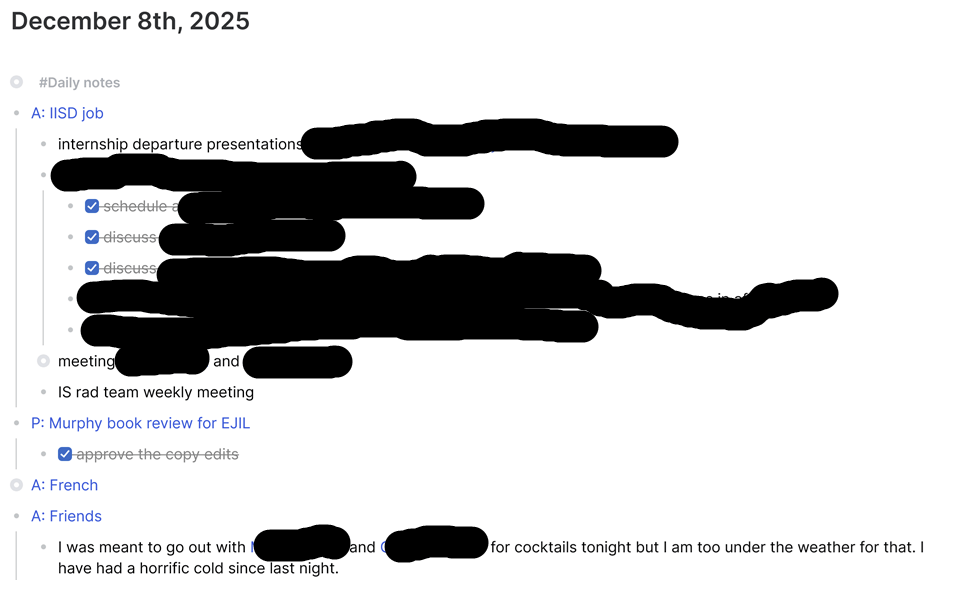
Each day that I log in, a new daily notes page is automatically generated and becomes my homepage. Here’s an excerpt from one of mine:

RIP my evening plans.

One of the most genius features of Roam is the bidirectional links. It’s very simple to create a new page: when you’re typing on any page, just put double square brackets around a word or words, which then becomes an empty page. In the screenshot above, an example of a page is [[A: IISD job]], in blue. When you click on [[A: IISD job]], at the bottom you can see every time [[A: IISD job]] has been mentioned on any other page. That simple improvement in functionality enables all kinds of linkages to form and be recognised.

The bidirectional links mean that if I click on, for example, [[A: IISD job]] I can see all my notes relating to my job, organised under each day (and also under projects & any other pages I’ve created relating to my job).

Project management

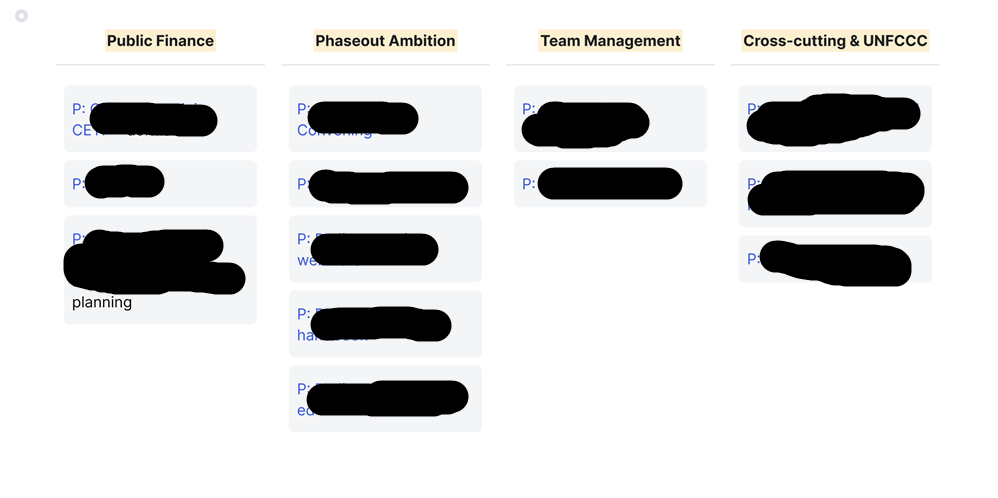
One of the main things I’ve used Roam for is project management. It’s easy to create kanban boards, for instance. Here’s an example of one of mine:

Lol sorry about the redactions, but you get the idea

I use “P” in my page titles to stand for “project”. At a glance I can see everything I have on my plate. When I worked as an academic, I had a kanban for papers I had on the go, with a column for each stage of the publication process.

I still technically have that kanban, it’s just a bit empty now.

Each project has its own page, which contains timelines, to-dos, links to relevant people, reading notes, and back-links to the notes I take on my daily notes page related to that project. On that page I can also set reminders for myself that automatically pop up on my daily notes (ie my homepage) on a given date. That is very handy for managing project timelines.

Powerful reading notes

A second way I use Roam is to make reading notes. These aren’t just any reading notes, however. Any time I’m making notes from something I’m reading, and the writer refers to another work, be that a book, legal case, or blog post, I can very easily create a page for that new reference and, if I want, create a reminder for myself to read it. If I’ve already read that other work, even better – I can link to my pre-existing page about it.

This was a true game-changer when writing my book. I could easily navigate the web of citations among case law, international treaties, and secondary literature.

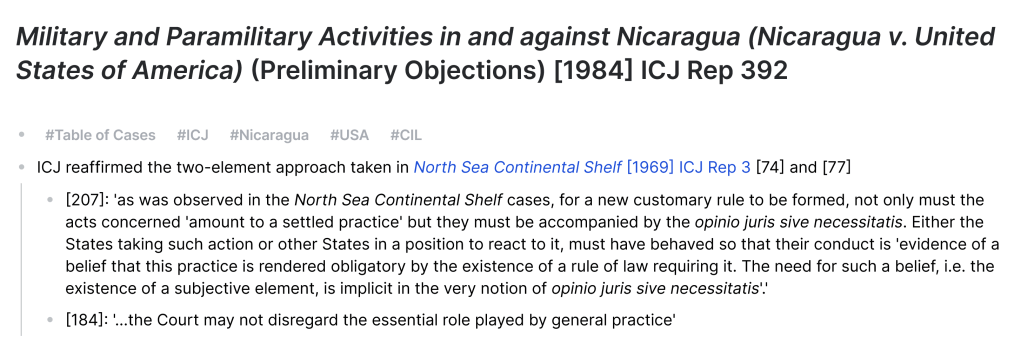
An example from an (old!) reading notes page. The tags function as pages as well — so if I click on #CIL, for instance, I can see all the notes I’ve ever taken relating to customary international law.

It’s not only easy to link to another page — you can even link to a single block (bullet point) within that page. I have outlined entire academic articles this way — incorporating notes and quotes from various sources structured with my own thoughts. The writing process is never easy or simple, but at least with this technology it’s possible to gather one’s sources effortlessly. And, speaking of effortlessness…

Effortless relationship management

I hate to break it to you, but if we’ve ever interacted since December 2019, you probably have a dedicated page in my Roam.

All I have to do is type in a name in Roam, with some square brackets around it, and it creates a page. When I click on that page I can see a record of every time I’ve made a note of our meetings/interactions for the last 6 years, alongside anything I want to remember about that person (how we met, their birthday, what have you).

It’s quite fun because often I’ll come across things I completely forgot about. It’s like a journal, but supercharged.

Why not Notion/Obsidian/etc?

In the years since Roam was reallly big in, like, 2020-2021, several other note-taking apps have taken off. Why not switch?

Okay, so…. the answer is partly “lock-in.” In no other app can I easily see what I was reading, writing and thinking in 2020. Yes, I could in theory export all my pages from Roam and upload them into another app. But for that hassle I’d want to see clear advantages, and no other app has demonstrated these. Yes, Notion is prettier. But is it that much better than Roam? Having played around with it, I don’t think so.

The other main reason is that I just really like Roam and have no desire to switch. The hype has largely passed, but the underlying product is still solid. It’s completely intuitive to use at this point, and feels cosy.

I also have a lot of respect for Roam as the note-taking app that changed the game. A lot of other apps have essentially copied it (and I hear even EverNote has implemented bidirectional links these days) but Roam was the first of its kind, and to me that inspires loyalty.

Finally, Roam has never tried to force generative AI on its users. This is a big one. It feels like the Roam team really value actual human thought. And so do I.

How does all of this interact with my paper notebook?

If you know me from work then you’ll have seen me toting around my large black notebook. There are three reasons for this. First, quite simply, it’s not always convenient or appropriate to be typing notes on a laptop at an in-person meeting. Second, I find that I retain more information when I hand-write.

Third, it’s often quite nice to be able to take oneself away from screens in order to do some deep work. Of course, if my hand-written pages are any good I’ll be transferring them to Roam later. But sometimes it’s just about the process of hand writing itself.

When I’m using my paper notebook, which isn’t every day, at the end of each day I note down the key points/highlights in Roam as far as they’re useful.

Inspired?

I feel like I’ve barely scratched the surface of what I use Roam for and why I like it.

If you are inspired by this post to check out Roam, let me know how you get on! I’d be interested to hear your experience. Or let me know what other app you use & love.

What I Read in 2025

It’s been five years since I did a round-up of my 2020 reading. I had good feedback on that post, with many people telling me it had inspired them to pick up a book. After several years of not keeping good track of my reading, I decided to do it again — both for my own interest, and hopefully to again give others some inspo for their TBR piles.

The main question I got from last time was: how do you read so much? The main reasons are:

  1. I don’t own a TV. I have next to no desire to watch TV and this means I have a lot of time that other people might spend on watching series.
  2. I read quickly. I always have done. But I have no good tips to increase your reading speed, sorry.
  3. I have a truly excellent public library that uses a great e-book/audiobook app called Libby. Probably about 3/4 of the books I read this year, I read on Libby — for free! I highly recommend finding yourself a public library.

The main thing that’s changed from 2020 is that reading books no longer forms a significant part of my full-time job. Now, I read almost exclusively in mornings, evenings and weekends. If there’s one thing I miss about academia, or at least the privileged version of it that I occupied, uninterrupted hours of reading time is that thing.

The second thing that’s changed is that I got really into audiobooks this year. I listened to books while running, gymming, walking, hiking, on the Overground, on the bus, on the tube, on the aeroplane — everywhere. But for some reason I can only listen to non-fiction. Fiction I save for reading visually.

Upon reviewing the below, what stands out to me is that I was big into memoir this year. Queer fiction/memoir in particular formed a big theme. Conversely, I read less political economy than in the past, preferring lighter fare.

Without further ado, here’s the list:

Fiction

  • All That We Know by Shilo Kino. Very funny and cutting.
  • Poorhara by Michelle Rahurahu. I found the sections in text slang quite hard to read but other than that really enjoyed this book.
  • Amma by Saraid de Silva. I liked the way that certain characters’ hair almost became its own character in the story.
  • Chrysalis by Anna Metcalfe. Quite strange and I’m not sure whether I enjoyed it.
  • Pond by Claire-Louise Bennett. I was very late to the Pond party, but so glad I got there in the end. A wonderfully weird book.
  • But the Girl by Jessica Zhan Mei Yu. I loved the intertextuality of this book, especially the commentary on Sylvia Plath.
  • The Ministry of Time by Kaliane Bradley. One of my top four books of 2025. An absolute ripper of a novel.
  • Waist Deep by Linea Maja Ernst. I read this straight after MoT and found the contrast somewhat jarring as this book contains so much interiority whereas the other is very plot-driven. Will read again at another time.
  • Ordinary Saints by Niamh Nì Mhaoilcoin. Weirdly foreshadowed certain aspects of my year.
  • Detransition, Baby by Torrey Peters. Also late to the party on this one, which I really enjoyed.
  • Things Fall Apart by Chinua Achebe. This made me want to read more by him.
  • Fair Play by Tove Jansson. Ah, Tove Jansson! This book was absolutely glorious.
  • Stag Dance by Torrey Peters. I wished the short stories had each been novels in their own right.
  • Purple Hibiscus by Chimamanda Ngozi Adichie. My favourite of hers that I’ve read so far, and utterly devastating.
  • Convenience Store Woman by Sayaka Murata. Just as good as everyone says.
  • Gunk by Saba Sams. This book made me want to live in Brighton.
  • Swimming Home by Deborah Levy. Omg this book.
  • Intermezzo by Sally Rooney. My favourite Rooney so far. I loved the way the chapters for each of the brothers differed in style and tone.
  • The Words of Dr L by Karen E Bender. This book should be better known.
  • Eileen by Ottessa Moshfegh. The twist near the end is utterly spine-tingling.
  • The Summer Book by Tove Jansson. A classic for a reason.
  • Filthy Animals by Brandon Taylor. Not much to say except that I really enjoyed it.
  • All Fours by Miranda July. I loved this; it’s hilarious.
  • On the Calculation of Volume I by Solvej Balle. Oddly compelling. I cannot wait to read the sequels.
  • Aerth by Deborah Tompkins. Reminds me of Ursula K Le Guin’s writings, in that it’s as much about politics and economics as it is about science and technology.
  • Whale Fall by Elizabeth O’Connor. Completely devastating and a strong contender for one of my favourite books of the year.
  • Earthlings by Sayaka Murata. Very weird.
  • Saga (Volumes 1-11) by Brian K Vaughan and Fiona Staples. So good. Thanks to Bernard for the recommendation.
  • I Gave You Eyes and You Looked Towards Darkness by Irene Solà. This book really leans into the grotesque and gets quite weird.
  • Vanishing World by Sayaka Murata. Also very weird.
  • Consider Yourself Kissed by Jessica Stanley. Very nice to read something set in my corner of London.
  • Universality by Natasha Brown. Very clever; I loved the characters.
  • Since the World is Ending by Indyana Schneider. Schneider writes about classical music in a way no other author I’ve encountered does. Her descriptions of pieces flow perfectly into the story.
  • The City and its Uncertain Walls by Haruki Murakami. Completely haunting.
  • Wild Boar by Hannah Lutz. Primal and strange and very good.
  • Enter Ghost by Isabella Hammad. I think I talked about this book to everyone I met for about a month. So good.
  • Dream Count by Chimamanda Ngozi Adichie. I wanted the whole book to have been from Kadiatou’s perspective.
  • Territory of Light by Yuko Tsushima. The light in the apartment! So good.
  • Moderation by Elaine Castillo. A strong contender for one of my favourite books of the year, and probably my second favourite novel.
  • Girlbeast by Cecilie Lind. Probably the most distinctive and poetic writing style of any novel I’ve read this year. Expanded my conception of what a novel can be.
  • The South by Tash Aw. Heartbreaking and very good.
  • La Belle Sauvage by Philip Pullman. Re-read and much better the second time around.
  • Lyra’s Oxford by Philip Pullman. Re-read, and my favourite of PP’s “little” books.
  • Once Upon a Time in the North by Philip Pullman. Re-read.
  • Serpentine by Philip Pullman. Re-read.
  • The Collectors by Philip Pullman. Not a re-read, and quite weird.
  • The Imagination Chamber by Philip Pullman. Very sweet and nostalgic.
  • The Secret Commonwealth by Philip Pullman. Re-read, and also much better the second time around.
  • The Rose Field by Philip Pullman. I loved this (albeit with some major quibbles).
  • Hospital by Sanya Rushdi. Everyone should read this book.

Poetry & Letters

  • Time is a Mother by Ocean Vuong. What to possibly say about Vuong. I’ll be returning to this book.
  • Love Letters by Virginia Woolf and Vita Sackville-West. Will someone be publishing books of whatsapp messages one day??
  • In the Hollow of the Wave by Nina Mingya Powles. I loved how this book integrated sewing, fabric and texture.
  • Echidna by essa may ranapiri. I loved essa’s first collection and I loved their second too.
  • Wild Dogs Under My Skirt by Tusiata Avia. Evocative and quite lovely.
  • Giving Birth to My Father by Tusiata Avia. Hit me right in the heart.

Memoir & Essays

  • Arrangements in Blue by Amy Key. Loved it; quite insightful on Joni Mitchell.
  • Swimming Studies by Leanne Shapton. One of my top four books of 2025, serendipitously picked up in the marvellous D&Q bookshop in Montreal.
  • Desperately Seeking Semen by Hayley Hendrix. Picked up from my building’s lobby/community library, this is a one-of-a-kind account of the author’s quest to have a child.
  • Things I Don’t Want to Know by Deborah Levy. I already know I’ll be coming back to this trilogy (+TPOS) time and time again.
  • The Cost of Living by Deborah Levy.
  • Real Estate by Deborah Levy.
  • The Position of Spoons by Deborah Levy.
  • Uncommon Measure by Natalie Hodges. This book has some really great descriptions of what Bach’s music is like.
  • Not That I’d Kiss a Girl by Lil O’Brien. Hilarious.
  • Fun Home by Alison Bechdel. Bechdel is brilliant.
  • Minor Feelings by Cathy Park Hong. I don’t remember much about this book, which I’m not sure is an indictment of it or of me.
  • The Collected Schizophrenias by Esme Weijun Wang. The hype around this book was totally deserved.
  • A Man’s Place by Annie Ernaux. Honestly all the Ernaux I read this year kind of blurred into one. It was all moving, gutting, and transcendent.
  • Happening by Annie Ernaux.
  • Simple Passion by Annie Ernaux.
  • The Young Man by Annie Ernaux.
  • Exteriors by Annie Ernaux.
  • Love in Exile by Shon Faye. Of course love is political, we all knew it, but this book spells it out in the most gripping way. Also, it’s laugh-out-loud funny.
  • The Loves of My Life by Edmund White. Stunning.
  • The Centre Cannot Hold by Elyn R Saks. Lucid and compelling.
  • Pageboy by Elliot Page. Trans rights = human rights.
  • Readme.txt by Chelsea Manning. A remarkable story.
  • Tiny Moons: A Year of Eating in Shanghai by Nina Mingya Powles. A re-read; made me hungry.
  • Bluets by Maggie Nelson. Another re-read of this mysterious and enigmatic little book.
  • The Woman In Me by Britney Spears. Picked up from a sidewalk library in Machynlleth, this was a surprisingly good read.
  • Translating Myself and Others by Jhumpa Lahiri. I think I would have benefited from reading other works of hers before jumping straight into this one.
  • Mom & Me & Mom by Maya Angelou. I always wonder at how people who write memoirs about their childhood manage to remember so much in so much lucid detail, and this book is no exception.
  • Crying in H Mart by Michelle Zauner. Vital; manages to transform heartbreak into something transcendent.
  • Completely Normal and Totally Fine by Rosie Viva. Unexpectedly laughed out loud during this one.
  • I Want to Die But I Want to Eat Tteokbokki by Baek Sehee. The author passed away while I was reading this book — RIP.
  • Careless People by Sarah Wynn-Williams. One of my top four books of 2025. Totally wild and I think I’ve recommended it to everyone I know at this point.
  • Slowing the Sun by Nadine Hura. Essential reading–especially on connections between colonisation and climate change.
  • Kissing Girls on Shabbat by Sara Glass. Soooo good. One of the best memoirs I read this year.
  • Pathemata by Maggie Nelson. A compact book ostensibly about one thing (jaw pain) but actually about a lot of things (grief, love, covid…)

Society, Politics & Economics

  • Becoming Tangata Tiriti by Avril Bell. Packs a lot into a little book.
  • Perfect Victims and the Politics of Appeal by Mohammed El-Kurd. One of the best books I’ve read about Palestine.
  • No Straight Road Takes You There by Rebecca Solnit. Solnit does it again!!
  • The Transgender Issue by Shon Faye. Required reading, and has only aged better over time.
  • Doppelganger by Naomi Klein. Loved this, especially the attempt to engage properly with conspiracy theorists.
  • One Day, Everyone Will Have Always Been Against This by Omar El Akkad. Oof. This book really hammers it home.
  • Minority Rule by Ash Sarkar. I honestly can’t remember much about this book, alas!
  • Recognising the Stranger: On Palestine and Narrative by Isabella Hammad. A short yet vital account of the stories we tell.
  • The Unsettled by Richard Shaw. One in the great tradition of books by Pākeha attempting to understand and ‘unsettle’ their family history.
  • Butts: A Backstory by Heather Radke. A fun and funny romp through the cultural history of bums, which of course ends up being all about gender and race.
  • Empireworld by Sathnam Sanghera. An insightful account into how the legacies of British empire permeate the whole world. Thanks to Alisha for the recommendation.
  • We, the Heartbroken by Gargi Bhattacharyya. Ideal bath reading.
  • The Financial Colonisation of Aotearoa by Catherine Comyn. This book is essential for understanding Aotearoa New Zealand’s past and present. I learned a lot!

International Law

  • The Human Right to Resist in International and Constitutional Law by Shannonbrooke Murphy. I reviewed this book for EJIL and shortly you’ll be able to read my review!

Nature, Climate & Environment

  • The Language of Climate Politics by Genevieve Guenther. Guenther expertly exposes the narratives and language used by climate deniers/delayers.
  • Crude Britannia by James Marriott and Terry Macalister. I liked the way they wove in music into the book, which is otherwise about oil politics and economics.
  • All We Can Save by Ayana Elizabeth Johnson and Katharine K Wilkinson (eds). Beautiful and powerful essays.
  • The Destruction of Palestine is the Destruction of the Earth by Andreas Malm. Highly recommend this book for anyone who wants to know about the longue durée of Palestine and climate.
  • Thirst by Robert Macfarlane et al. A short collection of essays and poems about fresh water: vital.
  • Dispersals by Jessica J Lee. Very beautiful and ideal hiking reading.
  • Strata by Laura Poppick. Makes me wish I had studied geology!
  • Here Comes the Sun by Bill McKibben. Maybe the most uplifting climate book I read this year. Solar is the future (and, increasingly, the present).
  • Is a River Alive? by Robert Macfarlane. One of my top four books of 2025. I recommend the audiobook version (read by the author).
  • The Climate Diplomat by Peter Betts. An indispensable insider account of climate negotiations. The descriptions of UK civil service politics are especially enlightening/frustrating.
  • The Long Heat by Wim Carton and Andreas Malm. Compelling and well-argued account of how not to tackle climate change.

Music

  • Nurtured by Love by Shinichi Suzuki. After reading several books by Dr Suzuki this year, this is the only one that you really need, in my opinion.
  • House of Music by Kadiatu Kanneh-Mason. Oh my word. Kadiatu is quite a woman.
  • Memories of Dr Shinichi Suzuki by Lois Shepheard. A very nice account of one woman’s time in Matsumoto.
  • Shinichi Suzuki: His Speeches and Essays by Shinichi Suzuki. A bit repetitive with other Suzuki books.
  • Ability Development from Age Zero by Shinichi Suzuki. My second-favourite of Suzuki’s books.
  • Suzuki: The man and his dream to teach the children of the world by Eri Hotta. The definitive account of Suzuki — very well researched and written.
  • Man and Talent: Search into the unknown by Shinichi Suzuki. This one comes across as a bit dated.
  • Quartet by Leah Broad. A really well-researched group biography of four women composers in the 20th century. I loved this book especially because it introduced me to a lot of music I hadn’t heard before.

Management

  • The Making of a Manager by Julie Zhuo. I read this for work, since I’ve recently become a manager, and found it really helpful.

My advice for a student hoping to get a job in climate

Every month I speak to at least two or three students who have reached out to me, usually on LinkedIn, who are hoping to get a job once they graduate in the climate space. I figure for each of these people there are probably two more who would love to know this information but for whatever reason don’t like to send cold connection requests.

As a caveat, my experience specifically comes from working in climate policy, in a thinktank. The climate space is much bigger than policy. I can only write to what I know. Your mileage may vary!

Without further ado, here’s the advice I wish I had as a student. It boils down to four things: learning, networking, getting (relevant) experience, and volunteering. Most of this is probably pretty generic to any field! But, regardless, here’s what I think.

1. Learn

You may already be studying something extremely relevant to tackling climate change, like geography or environmental science. But, like me, you may be studying a relatively unrelated field, like economics, politics or law, where papers about the environment form a minority of your courseload. Regardless, there’s a lot you can do to increase your knowledge of climate.

I’d recommend reading books, both new releases and classics. For me, books that made a big difference early on in my climate journey were things like This Changes Everything by Naomi Klein, Hope in the Dark by Rebecca Solnit, and Fossil Capital by Andreas Malm. More recent releases that have taught me a lot include books like A Planet to Win by Daniel Aldana Cohen et al, The Climate Diplomat by Peter Betts and Overshoot and The Long Heat by Andreas Malm and Wim Carton.

For staying up to date with current affairs, I’d recommend newsletters. Carbon Brief do an indispensable daily/weekly newsletter. If climate diplomacy is your bag then look no further than the Climate Diplomacy Briefing. But there are others. Podcasts can also be good.

Finally, there are webinars. A lot of think tanks and NGOs regularly hold online events where they discuss their latest research or campaigns. Keep an eye out for these by trawling the websites of organisations that you like the look of. This is a good way to take the temperature of where the cutting edge is.

2. Network

I know. Networking is so painful (especially for an introvert like me). But it has to be done.

LinkedIn is one thing (my main piece of advice for LinkedIn is to always, always send a specific and tailored message with your connection request). However, there’s no substitute for in-person networking.

If you’re in London or within a reasonable distance, there’s no excuse not to be turning up to events. Every month there are climate events put on by various universities, think tanks and NGOs. If you don’t know where to start, search on Eventbrite. Each June there is London Climate Action Week, where hundreds of events take place. There are monthly London climate drinks. Heaps of opportunities to meet people in the sector that you want to work in. The same advice goes if you’re in any big city.

Networking at an event isn’t hard. The small talk script basically writes itself: “What made you come to this event?” “What did you think of speaker X?” “What’s your biggest takeaway?”

3. Get (relevant) work experience

When it comes time to apply for your first graduate job, having (relevant) work experience will set you above the rest.

Undergraduates have long summers, which are perfect for working. Meanwhile, a PhD is 3-4 years long and most universities will let you work alongside your studies to some extent (Cambridge lets you work for up to 10 hours a week). Taking an internship one day a week for a few months is a good way to broaden your horizons while not distracting too much from your thesis.

How to find internships in the climate space? There’s no easy answer. While there are definitely some advertised (to find these I recommend trawling the websites of organisations that you admire), I personally had no luck with applying for these. Instead, I got two of my internships via completely cold emails. My advice for cold emails is to be as specific as possible about why you admire the organisation’s work, what you could bring to the organisation, and always attach your CV.

What to do if you can’t find an internship in climate? Don’t panic. Almost any internship/work experience will give you transferrable skills, which you can leverage in job applications later on. For example, does this internship give you experience in written and oral communication? Does it teach you data analysis, project management, or research? If so, great. All of these skills are indispensable in my current job.

The other good thing about internships is that they’ll also teach you what you like or don’t like about a given workplace or sector. You may find once you do an internship, for instance, that you don’t actually like or want to work in climate, or in a given type of organisation! That’s extremely important information to know.

4. Volunteer

It’s not always possible to get paid work experience in the climate field. Meanwhile, there’s lots of relevant experience to be had in the voluntary sector. There are a myriad of climate organisations, ranging from student societies to NGOs, who rely on volunteers to get things done. There are all sorts of different roles available and it’s a way to gain relevant experience and relevant knowledge, as well as demonstrate dedication.

Personally, during my PhD I got involved in my college’s divestment campaign. Engaging with a big, old institution to try and get it to change its ways when it came to investment in fossil fuels taught me a lot of skills that I now use in my job. I think it also counted as a plus in my job application as it showed commitment to the cause.

Of course, it’s not always possible to volunteer. Maybe you have caring responsibilities or work many hours a week already. If that’s the case, don’t panic. Volunteering definitely isn’t necessary to find a job later on. But if you can do it, I recommend it.

Good luck!

I hope this post was helpful. My only request of you is that, please, if you do end up getting a job in the climate space, pay it forward and give your honest advice to those who will inevitably ask you the same questions that I get asked all the time.